When you buy through links on our articles, Future and its syndication partners may earn a commission.

Astronomers have spotted the most distant and brightest "space laser," or megamaser, ever seen, and it's blasting out from a collision between galaxies that occurred when the universe was just half its current age.
This galaxy system, designated HATLAS J142935.3–002836, is emanating light that needed to travel for about 8 billion years before it reached the MeerKAT radio telescope in South Africa. The laser is specifically a hydroxyl megamaser, meaning it is similar to a laser but is seen in microwave or radio wave radiation rather than in visible light. The prefix "hydroxyl" refers to the fact that this space laser was created when hydroxyl molecules, each composed of one oxygen and one hydrogen atom, smashed into one another within the gas-dense, colliding galaxies.
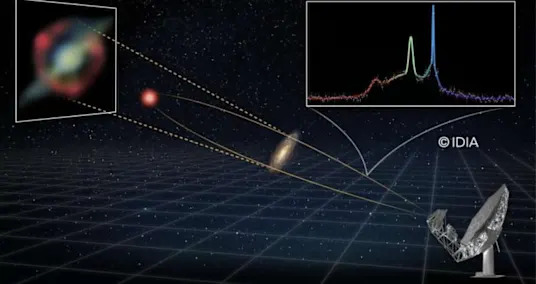
Even with its impressive brightness, HATLAS J142935.3–002836 wouldn't have been visible if it weren't for the influence of gravity on the fabric of space, aka the concept of gravitational lensing. This phenomenon was first predicted by Albert Einstein in his magnum opus theory of how gravity works, general relativity, back in 1915, and is still a key tool for astronomers exploring the universe.
Gravitational lensing describes what happens when light from a distant source, our megamaser in this case, passes by warps in spacetime caused by an object of great mass, like a cluster of galaxies. The closer that light passes to the warping object, or gravitational lens, the more strongly its otherwise straight path gets curved. As a result, light from the same object can arrive at our telescopes at different times, and this magnifies the background object.
"We discovered a very distant hydroxyl megamaser using the MeerKAT radio telescope. The signal comes from a galaxy at high redshift and is strongly magnified by gravitational lensing," discovery team leader Thato Manamela of the University of Pretoria told Space.com. "This magnification makes the emission easier to detect and allows us to study a system that would otherwise be too faint to observe."
Manamela added that megamasers are rare based on studies conducted in the near universe, usually found in bright infrared galaxies that contain huge amounts of gas and dust. These environments are often the result of two or more galaxies colliding and merging to birth a new "daughter" galaxy. Mergers like this trigger bouts of intense star formation, as well as creating the physical conditions that allow the hydroxyl molecules to amplify radio emission.
"This megamaser is unusual because it is located at a very large distance. That means we are observing it from a much earlier time in the universe," Manamela continued. "The signal is also gravitationally lensed, which boosts the brightness and provides a natural magnifying effect. This combination makes it one of the most distant and powerful hydroxyl megamasers known."
The fact that a megamaser is erupting from this galaxy collision indicates the presence of dense molecular gas and intense activity.
"By studying the emission lines, we can learn about the gas kinematics, the physical conditions in the galaxy, and the processes driving star formation," Manamela said. "Megamasers can also act as indicators of dual active galactic nuclei or pairs of supermassive black holes, systems that are expected to produce gravitational waves."
"This will help us understand how common megamasers were in the early universe and how they relate to galaxy evolution and star formation," Manamela concluded.
The team's research has been accepted for publication in the Monthly Notices of the Royal Astronomical Society Letters and is available as a preprint on the paper repository server arXiv.
latest_posts
- 1
 Kona SUV: Exploring the Future with Hyundai's Visionary Hybrid
 - 2This Week In Space podcast: Episode 186 — Snow on the Moon?
- 3The Leonid meteor shower is peaking early this week. Here’s what to know
- 4Washington resident is infected with a different type of bird flu
- 5IDF kills senior PIJ Gaza City Brigade cmdr. who infiltrated Kibbutz Nahal Oz on Oct. 7


- Trump declares Christmas Eve and Dec. 26 federal holidays: What does that mean?
- Polls open in tense Uganda election amid widespread delays
- I'm 18 and founded an AI startup. I have to wake up at 3 a.m. to work on it before school, but it's worth every sleepless night.
- 21 Things You Ought to Never Tell Your Childless Companion
- He walked on the moon in 1972. This is his advice for the Artemis II astronauts.
- UN mission says no evidence Hezbollah rearming in southern Lebanon
- Inside The Design-Forward Wellness Hotel Marking A New Chapter In Medellín
- Parents search for children missing since a volcanic eruption in Colombia 40 years ago
- Spots to Go Hang Floating