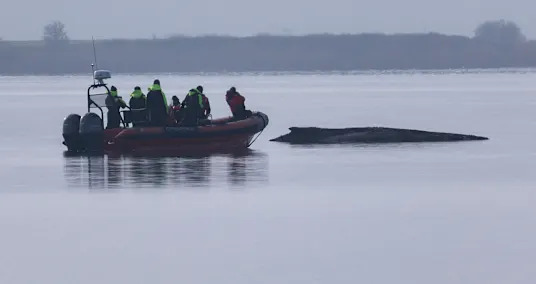
BERLIN (AP) — Rescuers said Wednesday that they have given up hope for the humpback whale that has become stranded repeatedly off Germany's Baltic Sea coast and now expect it to die in the inlet where it currently lies.
The whale swam into an inlet on the small island of Poel, near the port of Wismar, on Tuesday and got stuck again. Last week, it was rescued from even shallower water at Timmendorfer Strand, a resort town around 50 kilometers (over 30 miles) from its current location, with the help of an excavator, but it soon ran into trouble again.
In recent days, authorities have pursued a strategy of trying to give the exhausted mammal peace and quiet so that it can gather enough strength to swim away under its own steam, while sometimes approaching it with boats to motivate it to set off.
Burkard Baschek, the scientific director of the Ocean Museum Germany and the scientific coordinator of the rescue effort, said the whale was breathing at very irregular intervals on Wednesday and that drone photos showed little sign of activity in the sediment under the 12-15 meter (39-49 foot) animal. It barely reacted when approached.
The whale was a bit more active after rescuers left, “but it is not activity that gives us grounds for hope,” Baschek said at a televised news conference. “We firmly believe that the animal will die there.”
While the whale on two previous occasions was able to gather enough strength to free itself, it is now weaker and also faces falling water levels, “and the prospects that it will free itself are very small,” he said. “The approach of maximum rest and respect for nature demands at some point that we let it go.”
The drama captivated Germans, with the media sending detailed updates on its progress. The whale acquired the nickname “Timmy” during its coastal odyssey.
It was first spotted swimming in the region on March 3. It is not clear why the whale swam into the Baltic Sea, which is far from its natural habitat and it isn't suited to. Some experts say the animal may have lost its way when it swam after a shoal of herring, or during migration.
The animal always faced long odds to find its way out into the North Sea, itself a journey of several hundred kilometers (miles), and then to the Atlantic Ocean.
latest_posts
- 1
 The most effective method to Quick Track Your Outcome in Advanced Showcasing with a Web-based Degree
 - 2Coffee Prices Finish Higher on Brazil Cop Concerns
- 3Vote in favor of Your Number one Cake Type
- 4Watch interstellar comet 3I/ATLAS make its closest approach to Earth in free livestream on Dec. 18
- 5PHOTO ESSAY: Scientists trying to unravel one of the body's biggest mysteries


- Air superiority and long-range strikes: what China's war games say about how it might assault Taiwan
- Gov’t approves millions for border cities in North under Hezbollah fire
- German foreign minister heads to China to talk rare-earth exports
- What are the health benefits of whole milk for kids?
- Figure out How to Augment Eco-friendliness in Your Volvo XC40
- An Extended period of Voyaging Carefully: the World with Reason
- Iran war upends aviation strategies
- Earthquake in Indonesia kills at least 1 person and sets off small tsunami
- 3D Printers for Specialists